Robotic grinding: the force is the process, and the belt is the variable
A grinding robot that holds a position instead of a force is a robot that produces a different part every twenty minutes, because the belt wears.
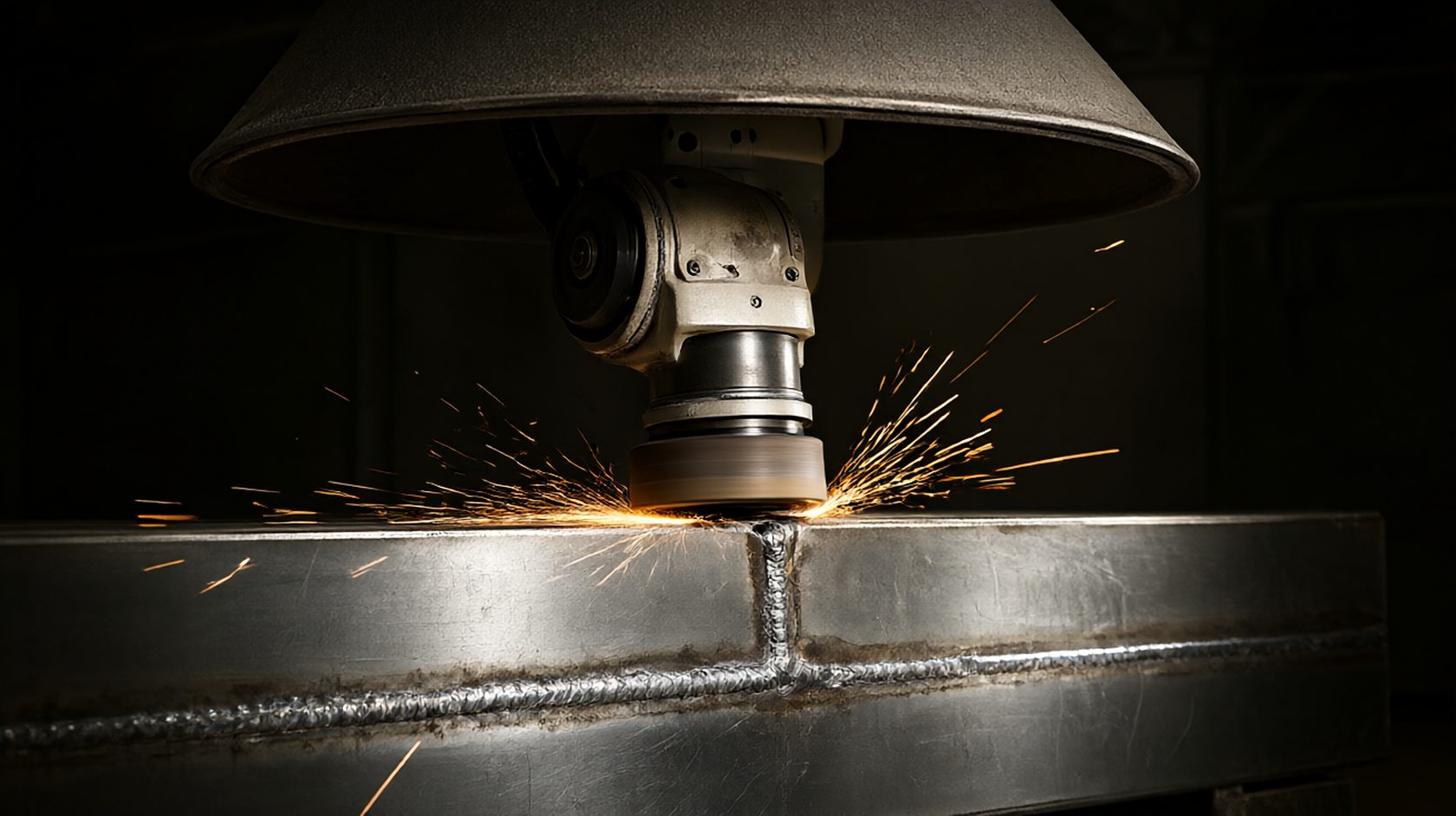
Position control and force control are different machines
A robot that grinds by following a path holds the tool at a position, and the material removed depends on the belt's condition and on the part's as-cast variation. Both drift.
A robot that grinds by applying a force holds the tool against the part with a controlled load, and the material removed depends on the belt's condition only. The path becomes a consequence of the force and the surface.
The second architecture is more expensive and it is the only one that holds a consistent removal rate on a cast or a welded surface. A position-controlled grinder is a machine that works on a machined surface and not on a casting.
The specification should state which architecture is used, because the same robot can be programmed either way and the part's consistency depends on the choice.
Belt wear: the curve nobody puts on the drawing
A new belt cuts fast because the grit is sharp and the bond is full. As it wears, the grit dulls and the bond recedes, and the removal rate falls along a curve that flattens after a break-in period.
The curve means a fixed force produces more removal at the start of a belt's life and less at the end, which is a dimensional drift across the belt's life and not across a single part. The drift is systematic and it is correctable.
The correction is either a force ramp through the belt's life or a belt change at a stated removal count. A belt changed on a time basis is a belt changed at a random point in its curve.
The specification should state the break-in procedure, the force schedule through the belt's life and the change criterion. A belt life given only in hours is a life measured on a machine that may not match.
Grit, bond and the finish they produce
The grit size sets the scratch pattern and the surface roughness, and the bond sets how the grit is held. A hard bond holds the grit and produces a finer finish for longer; a soft bond releases it and cuts cooler.
For stainless, a soft bond and a coarse grit cut fast and leave a deep pattern that has to be refined by a second belt. A two-step sequence is usual: a coarse belt for stock removal and a fine belt for the finish.
The finish specification should be a roughness figure rather than a grit number, because the same grit on two bonds produces two finishes. A roughness figure with a cutoff and a direction is a specification; a grit number is a purchase order.
The direction matters too: a belt ground across the part leaves a pattern that is visible under a highlight, and a part that is later polished shows the cross pattern through the polish.
Heat and the discolouration that is a corrosion site
Grinding generates heat, and on stainless the heat produces a temper colour that is a visible oxide and a depleted chromium layer. The colour is removed by the next step or it becomes a corrosion site.
A belt that is too worn, a force that is too high and a dwell that is too long all raise the temperature at the contact. The temperature is not measured and the colour is the evidence.
The remedies are a lower force, a faster traverse, a softer bond and a coolant. A coolant on a belt is unusual and it is the most effective at keeping the temperature down on a large contact area.
The specification should state the maximum temperature or, more practically, the acceptance for discolouration, plus the force and the traverse that produce it. A grinding procedure without a colour criterion is a procedure without a thermal limit.
Compliance and the force that is not the force
A force-controlled grinder measures the force through a sensor and the robot's compliance. A compliant tool holder with a spring introduces a position error that the controller compensates, and a worn spring is a force error.
The compliance is deliberate: it lets the tool follow a surface variation without a violent correction. A rigid tool with force control chatters; a compliant one absorbs the variation.
The compliance also sets the system's bandwidth, and a soft compliance makes the loop slow. A slow loop on a part with a short feature is a loop that never reaches the force.
The specification should state the compliance and the loop bandwidth, and should include a force calibration against a load cell at a stated interval. A force that is not calibrated is a force that is a setpoint.
Part variation: the casting that is not the model
A cast or a welded part varies from the model by a millimetre or more, and a position-controlled path removes a different amount on every part. The variation is the reason force control exists.
The variation has two components: a datum shift and a local shape error. A datum shift can be handled by a probing routine; a local shape error cannot, and it needs the force to absorb it.
The probe routine should measure the datum at three points and offset the path, and should reject a part that is outside a stated range. A part outside the range is a part that force control cannot save.
The specification should state the probing points, the datum tolerance and the rejection limit, and should record the measured values per part. A record per part is what turns a drift into a trend.
The sparks, the dust and the extraction that is a fire risk
Grinding stainless produces sparks and a fine dust, and the dust is combustible. An extraction system that collects it without a fire precaution is a system that can ignite the duct.
The extraction has to be at the contact point, with a velocity that captures the sparks before they travel, and the duct has to be cleaned on a schedule. A duct with a dust layer is a duct with a fuel.
Wet extraction removes the fire risk and adds a sludge disposal. Dry extraction with a spark arrestor is the usual compromise and it needs the arrestor maintained.
The specification should state the extraction type, the capture velocity and the cleaning schedule, plus the fire precaution. A grinding cell specified without an extraction specification is a cell with a hazard that is not in the risk assessment.
Dressing and the wheel that is not a belt
Some cells grind with a wheel rather than a belt, and a wheel needs dressing to stay sharp and concentric. A wheel that is not dressed loads and burns the part instead of cutting it.
The dressing interval is set by the removal rate and by the wheel's specification, and it should be a count of parts rather than a time. A wheel dressed on a schedule is a wheel dressed at an arbitrary point in its life.
The dresser itself wears, and a worn dresser produces a wheel that is not concentric. The dresser should be checked on the same interval as the wheel.
The specification should state the wheel specification, the dressing interval and the dresser check, and should include a concentricity check after dressing. A wheel specification without a dressing procedure is half a process.
Measuring the result without touching the part
A ground surface is measured by roughness and by profile, and both are usually checked off-line on a sample. An off-line check lags the process by the sample interval.
An in-process measurement, by a laser triangulation sensor or by a force signature, catches the drift earlier. A force signature that changes shape is a belt that has stopped cutting.
The signature is cheap and it is the most useful: a belt that is loaded produces a different force trace from a belt that is cutting. A cell that logs the force trace has a process monitor for free.
The specification should state the measurement method, the sampling frequency and the acceptance, and should require the force trace to be logged. A log is what makes a drift arguable.
A robotic grinding specification in eight lines
Eight lines cover a robotic grind: control architecture (force or position), belt specification with grit and bond, break-in procedure and force schedule through belt life, belt change criterion by removal count, surface roughness with cutoff and direction, discolouration acceptance with the force and traverse that produce it, compliance with loop bandwidth and force calibration interval, and extraction with capture velocity and cleaning schedule.
The lines describe a consumable-driven process, which is what grinding is. A grinding procedure that treats the belt as a constant is a procedure for one part of the belt's life.
The two lines that decide consistency are the force schedule through belt life and the probing routine, because those are the two that convert a drifting process into a controlled one.
Write the eight, log the force trace, and re-qualify when the belt supplier or the part's datum changes. Both move the removal rate.
A grinding cell specified with a force schedule through the belt's life is the robotic grinding system, and the schedule is what a single force setting cannot do.
- 01Control architecture named: force control or position control.
- 02Belt grit and bond stated, with a break-in procedure.
- 03Force schedule through the belt's life, not a single force.
- 04Belt changed on a removal count, not on a time basis.
- 05Surface roughness with cutoff and direction, not a grit number alone.
- 06Discolouration acceptance, with the force and traverse that keep it inside.
- 07Compliance and loop bandwidth stated; force calibrated against a load cell.
- 08Extraction capture velocity and duct cleaning schedule, with a fire precaution.