Longitudinal seam welding: the clamp sequence decides the seam before the laser does
A longitudinal seam is two edges held together for a metre. The distortion that ruins it is set by the clamping order, not by the weld parameters.
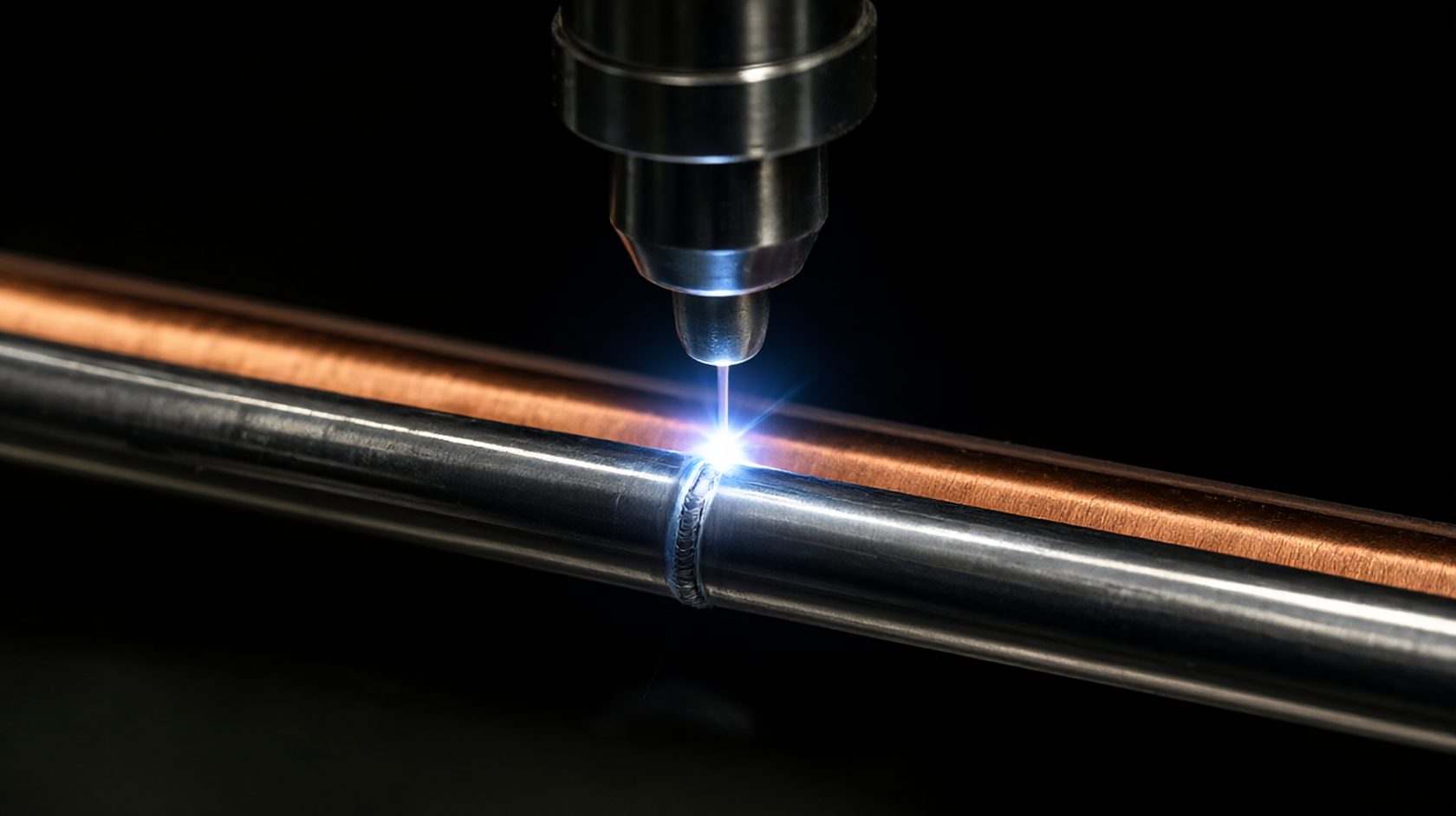
A seam is a fit-up problem with a welding machine attached
Longitudinal seam welding joins two edges along a straight run, usually on a tube, a box or a panel. The weld is fast and the machine is accurate, and the failure is almost always a gap that opened before the beam arrived.
The gap opens because the two edges were held at the ends and not in the middle, or because the heat of the first section released a stress that had been clamping the rest. Either way it is a fixture problem.
A laser is unforgiving about gap: a beam with a 0.2 mm spot will pass through a 0.5 mm gap and weld nothing. A TIG torch would bridge it and produce a bead that looks acceptable, which is why a process change from TIG to laser exposes fit-up that was always there.
So a longitudinal seam specification starts with the clamp and the edge preparation, and only then with the power and the speed.
Edge preparation and the square that is not square
A laser seam wants a square or a near-square edge with a controlled land, because the beam is narrow and the two faces have to touch over their full thickness. A sheared edge with a roll-over is a contact at one point and a gap behind it.
Shearing leaves a burnished zone and a fracture zone, and the split between them is at a fraction of the thickness. Two sheared edges with different split heights touch along a line rather than a face.
The usual remedy is a machined land of a stated height, or a shaved edge with a controlled burr direction. Both cost a process step and both convert a seam that fails at random into one that fails predictably.
The specification should state the land height, the squareness tolerance and the burr direction, and should check the edge on a section rather than by eye. A section through the joint before welding is the only honest fit-up record.
Clamping order and the stress it locks in
A seam is clamped from one end to the other, and the order matters because each clamp changes the shape the next clamp sees. A seam clamped from the middle outward traps a wave at the two ends; one clamped from one end forward pushes the wave ahead of the clamps.
The correct order for most longitudinal seams is from the centre outward in both directions, with a light pre-clamp before the final clamp. That pushes the residual wave to the ends, where a run-off tab can absorb it.
A seam clamped all at once by a bar is a seam whose gap depends on the flatness of the bar rather than on the parts. A bar that is straight to 0.1 mm over a metre is a bar that produces a gap at the ends if the parts are crowned.
The specification should describe the clamp sequence as a numbered sequence, and should include the pre-clamp force and the final force. A force without a sequence is half a clamping instruction.
Pre-set and the weld that pulls the seam closed
A weld shrinks as it solidifies, and on a longitudinal seam that shrinkage pulls the two edges together behind the beam. The seam closes as it is welded, which is why the gap at the end is smaller than the gap at the start.
That closing is useful when the gap is at the top of the tolerance and harmful when it is at the bottom, because a seam that closes too far produces an overlap and a bead that sits proud. The same programme produces different beads at the two ends of the tolerance.
The remedy is a pre-set: the edges are set slightly open at the start so that the shrinkage closes them to nominal by the end. The pre-set is a fixture feature and it is usually set by trial rather than by calculation.
The specification should state the pre-set as an angle or a gap change per metre, and should verify it by measuring the gap at three points after welding. A seam with no pre-set is a seam whose bead changes along its length.
Tack welds and the ones that leave a mark
A longitudinal seam is often tacked before clamping, and a tack is a heat input that leaves a distortion and a metallurgical notch. A tack that is inside the seam is harmless; one that sits on the finished surface is a cosmetic defect.
Tacks placed outside the seam and later removed leave a grind mark and a thinned section. Tacks placed inside the seam are consumed by the weld and leave nothing, which is the reason they are preferred on a visible part.
The tack pitch matters: a seam with tacks every hundred millimetres holds its gap better than one with tacks at the ends only, and the tacks resist the shrinkage that would otherwise close the seam ahead of the beam.
The specification should state the tack position relative to the seam, the pitch and the removal method. A tack specification that says only tack is a specification that leaves the position to the operator.
Run-on and run-off: the two ends that never match the middle
Every longitudinal seam has a start and an end where the heat input is transient, and both produce a bead that differs from the middle. The run-on tab and the run-off tab exist to move those transients off the part.
A run-on tab of the same thickness as the part lets the arc or the beam establish before it reaches the seam. A tab of different thickness changes the heat balance and produces a transition defect at the boundary.
A run-off tab lets the weld finish without a crater, and its length has to cover the decay of the power source. A short tab leaves a crater at the seam end, which is the crack initiation site that a fatigue test finds.
The specification should state the tab material, thickness and length, and should include them in the fixture rather than in the operator's discretion. Tabs that are added by hand are tabs that are sometimes missing.
Filler, gap tolerance and the two regimes
A longitudinal laser seam can be autogenous, with no filler, or with a filler wire. Autogenous welding needs a tighter gap because there is no material to bridge it, and it produces a harder, more brittle weld in some alloys.
A filler wire widens the process window at the cost of a wire feed to control. The wire diameter and the feed rate become part of the procedure, and a wire that is undersized for the gap produces a concave bead.
The choice is usually made on metallurgy rather than on fit-up: an autogenous weld in a high-carbon steel cracks, and a filler with a lower carbon content does not. A shop that switches to autogenous to save wire has changed the metallurgy.
The specification should name the regime and, if filler is used, the wire diameter, feed rate and any preheat. A procedure that says laser welding without saying autogenous or filler is a procedure with two meanings.
Distortion after the clamp is released
A clamped seam is welded in a stressed state, and releasing the clamps releases the stress. A seam that is straight under the clamps can bow, twist or potato-chip once the force is removed.
The distortion is set by the heat input, the clamp sequence and the symmetry of the section. A seam on the neutral axis of a symmetric section distorts less than a seam offset from it.
The measurement is a straightness check after release, on a surface plate or against a straight edge, recorded as a maximum deviation. A seam that is straight under clamps and 3 mm out after release has passed the wrong inspection.
The specification should include the release sequence and the post-release straightness tolerance, and should inspect after release rather than before. An inspection under clamps is an inspection of the fixture.
The seam that leaks: penetration and the root
A longitudinal seam on a vessel is a pressure boundary, and the failure mode is lack of penetration at the root rather than a crack on the surface. A bead that looks full can sit on a root that never fused.
Full penetration in a laser seam needs enough power density at the root, which depends on the thickness, the speed and the focus position. A focus that is set for a nice top bead is often too high for the root.
The check is a macro section at the start, the middle and the end of the seam, taken from a production part, with the penetration measured. A seam whose penetration varies by twenty per cent along its length is a seam with a gap or a focus problem.
The specification should state the required penetration and the section positions, and should make the section a first-off requirement rather than an audit. A pressure seam that is inspected by eye is not inspected.
A longitudinal seam procedure in eight lines
Eight lines cover a longitudinal seam: edge land height with squareness and burr direction, clamp sequence with pre-clamp and final forces, pre-set gap or angle per metre, tack position relative to the seam with pitch, tab material and length, autogenous or filler with wire and feed, required penetration with section positions, and post-release straightness tolerance.
The lines are a fixture specification with a welding procedure attached, which is the correct order for a seam. A welding procedure without the fixture lines describes a process that will not be reproduced.
The two lines that decide scrap are the clamp sequence and the pre-set, because both move the gap that the beam cannot bridge.
Write the eight, keep a production section from each setup, and re-qualify when the edge process or the clamp changes. A new clamp is a new seam.
The machine whose clamping sequence is written as numbered steps is the longitudinal seam laser welding machine, and the sequence is what keeps the gap inside the range the beam can bridge.
- 01Edge land height, squareness and burr direction stated and checked on a section.
- 02Clamp sequence written as numbered steps with pre-clamp and final forces.
- 03Pre-set gap or angle per metre, verified by measuring the gap at three points.
- 04Tack position relative to the seam, pitch and removal method stated.
- 05Run-on and run-off tabs specified in material, thickness and length, held by the fixture.
- 06Autogenous or filler regime named, with wire diameter and feed rate if filler.
- 07Required root penetration with macro section positions at start, middle and end.
- 08Straightness measured after clamp release, not under clamps.