U-type positioners: the second axis is a balance problem before it is a motion problem
A two-axis U positioner holds a weldment at a centre of gravity it does not know. The torque at the trunnion is set by the part, not by the payload rating.
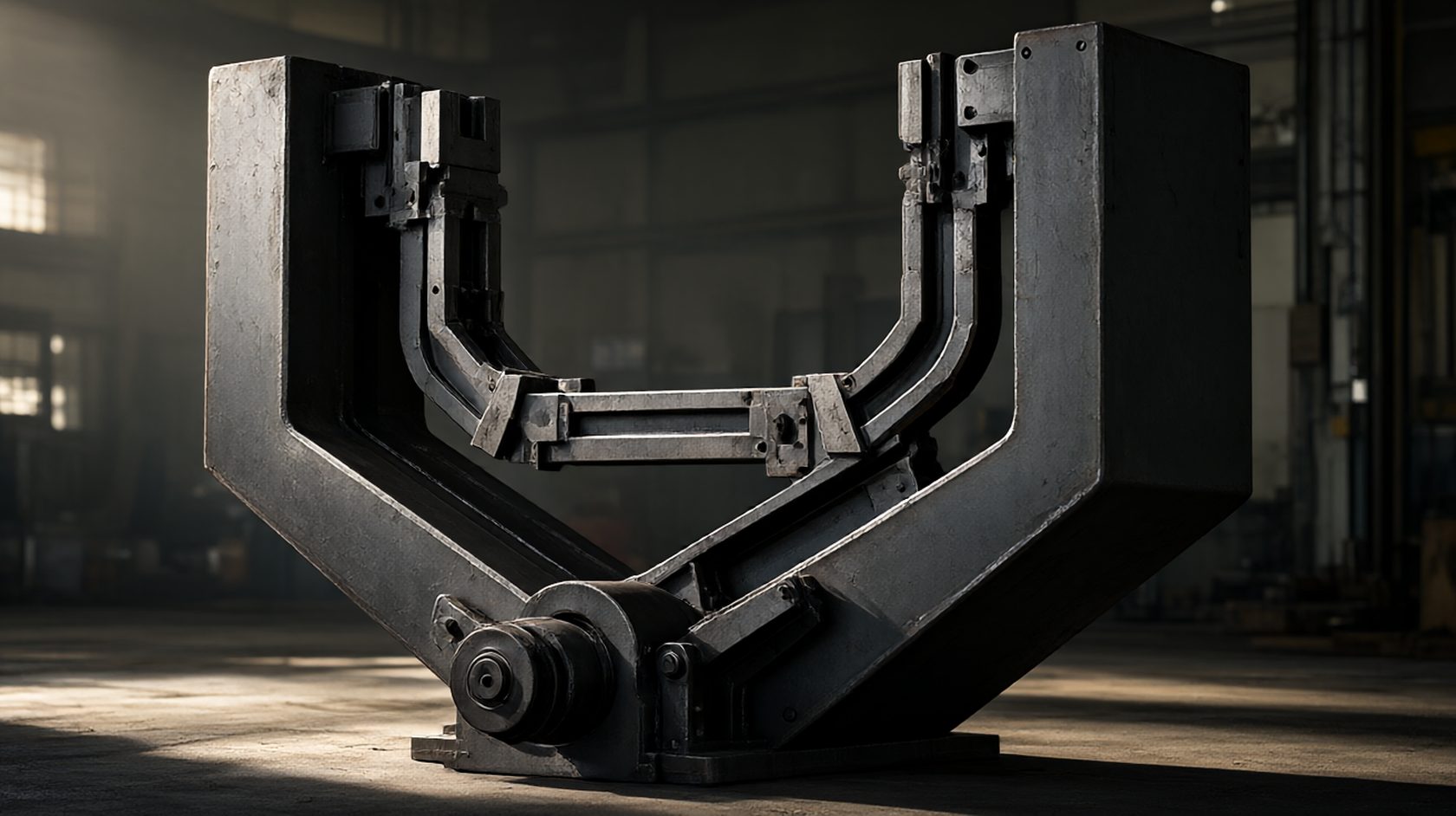
Two axes, two different loads
A U-type positioner has a rotation axis and a tilt axis, and the two see different loads. The rotation axis carries the part's mass off-centre; the tilt axis carries the whole assembly plus the offset.
A payload rating quoted as a single number describes the mass the positioner can hold, not the torque it can control. A part at the rated mass with its centre of gravity far from the axis is outside the rating in everything but the catalogue.
The torque at the trunnion is the mass times the distance from the axis to the centre of gravity, plus the moment of the fixture. A fixture that weighs as much as the part doubles the torque without changing the payload.
So the specification has two figures, not one: a payload and an allowable centre-of-gravity offset, and the second is the one that a fabricator cannot estimate from a drawing.
Finding the centre of gravity before the fixture is designed
The centre of gravity of a weldment is not the centroid of its outline; it is the mass-weighted point, and it moves as plates are added. A part that is symmetric in plan can be far off-centre in section.
The practical method is a weigh and a tilt, or a CAD mass property calculation with the plate thicknesses as built. A calculation on nominal thicknesses is a calculation that is wrong by the mill scale.
The offset should be measured on the first article with the fixture in place, not calculated for the bare part. The fixture's own mass and its position change the combined centre of gravity by more than most people expect.
The specification should state the allowable combined offset and the method for measuring it, and should require the measurement on the first article before the programme is released.
Torque, gearbox life and the duty that is not in the catalogue
A positioner's gearbox is rated for a torque and a duty cycle, and the duty cycle is usually omitted from the datasheet summary. A positioner used for continuous rotation at full torque has a shorter life than one used for indexing.
The life is set by the number of reversals as much as by the hours. A welding positioner that oscillates through a small angle reverses constantly and accumulates cycles faster than one that rotates a full turn.
The torque also varies within a rotation, because gravity assist and gravity resist alternate. A part that is balanced has a nearly constant torque; one that is offset has a sinusoidal torque with a peak at the top of the rotation.
The specification should state the peak torque, the reversing duty and the expected cycles per shift, and should compare them with the gearbox's rating rather than with the motor's.
Backlash and the weld that moves when the axis reverses
A positioner axis has a backlash, and a backlash of a few arc-minutes becomes a linear error at the part's radius. At a metre from the axis, five arc-minutes is about 1.5 mm.
The error appears when the axis reverses, because the backlash is taken up on the first move. A weld that oscillates through the same angle repeatedly is a weld where the backlash is always taken up, and the error is constant.
The failure is a positioner that holds position in one direction and lags in the other. A part welded in one direction is accurate; the same part welded on the return pass is offset.
The specification should state the backlash at the output flange, measured with a dial gauge at a known radius, and should require it to be checked after the first hundred hours.
Clamping: the part that moves after the fixture is locked
A weldment clamped at three points can still move at a fourth, and the movement appears as a weld that drifts. The clamp has to hold the part against the welding force, not only against gravity.
The clamping force is set by the part's stiffness, and a thin panel needs a distributed clamp rather than a point load. A point load on a panel deflects it, and the deflection is a gap at the seam.
The clamp also has to resist the thermal expansion of the weld, which pushes the part away from the seam as it heats. A clamp that holds the part at the start releases it at the end.
The specification should state the clamp positions, the force per clamp and the sequence, and should check the part's movement with a dial gauge during a weld. A clamp specification without a sequence is a clamp specification for a different part.
Cable and hose routing on a rotating axis
A rotating axis wraps cables around itself, and the wrap is either managed by a slip ring or by a cable that is allowed to wind and unwind. A cable that is allowed to wind has a finite number of turns before it fails.
A slip ring removes the limit and adds a maintenance item and a contact resistance. A cable that winds needs a rotation limit in the controller, and a limit that is not enforced is a cable that fails at the hundredth turn.
The hoses follow the same logic, and a water hose that winds is a hose that kinks. A kinked hose restricts flow and the torch overheats, which is a failure attributed to the torch.
The specification should state the routing method, the rotation limit and the hose type. A positioner without a rotation limit is a positioner whose cables are consumables.
Repeatability against the part, not against the encoder
A positioner's repeatability is quoted at the output, and the part's repeatability is at the part's surface. The two differ by the radius and by the fixture's own compliance.
A fixture that deflects 0.2 mm under the clamp load has a repeatability of 0.2 mm regardless of the positioner's 0.02. The fixture is the weak link and it is usually unspecified.
The measurement is a dial gauge on a datum feature of the part, run through the cycle ten times. A part that returns to within 0.1 mm has a system repeatability; one that returns to 0.4 mm has a fixture problem.
The specification should state the system repeatability at the part and the fixture stiffness that supports it. A repeatability figure without a fixture is a figure for a positioner, not for a cell.
The fixture weight nobody subtracts
A positioner's payload rating is for the part, and the fixture is often assumed to be light. A fixture for a large weldment can weigh more than the part, and its mass is at a larger radius.
The combined centre of gravity moves toward the fixture as the fixture's share of the mass grows, and the torque grows with it. A part that is within the rating becomes outside it once the fixture is counted.
The specification should state the payload as part plus fixture, and should require the fixture's mass and centre of gravity on its drawing. A fixture drawing without a mass is a fixture that cannot be assessed.
The check is a weigh of the assembled fixture before the first part is loaded. A fixture that exceeds the allowance is a fixture that has to be lightened before the cell is released.
Safety: the stored energy of an offset load
An offset load on a tilt axis stores energy, and a brake failure releases it. A positioner that loses power with an offset part can rotate under gravity until the part hits a stop.
The brake has to hold the peak torque with a margin, and the margin should account for the fixture and for a part that is heavier than nominal. A brake sized for the rated payload and not for the peak torque is a brake that slips.
The stop has to be positioned so that the part cannot reach a person or a cable when it swings. A stop that is placed for convenience rather than for the swing is a stop that protects the machine.
The specification should state the brake holding torque with its margin, the stop positions and the guarded envelope. A positioner specified without a swing envelope is a positioner specified without a hazard.
A U-type positioner specification in eight lines
Eight lines cover a U-type positioner: payload as part plus fixture, allowable combined centre-of-gravity offset with its measuring method, peak torque and reversing duty with cycles per shift, output backlash at a stated radius, clamp positions with force and sequence, cable and hose routing with a rotation limit, system repeatability at a part datum, and brake holding torque with stop positions.
The lines are a balance specification more than a motion specification, which is what a two-axis positioner is. A positioner that is within its mass rating and outside its torque rating will move and will not hold.
The two lines that decide the weld are the centre-of-gravity offset and the backlash, because those are the two that a catalogue payload number conceals.
Write the eight, weigh the fixture, and re-check the offset when the part design changes. A stiffener added to a weldment moves the centre of gravity by more than the drawing revision suggests.
The positioner whose payload is stated as part plus fixture is the dual axis U type positioner, and that definition is what makes the torque rating meaningful.
- 01Payload stated as part plus fixture, not as part alone.
- 02Allowable combined centre-of-gravity offset with a stated measuring method.
- 03Peak torque and reversing duty compared with the gearbox rating, not the motor.
- 04Output backlash measured at a known radius, and re-checked after a hundred hours.
- 05Clamp positions, force per clamp and clamping sequence stated.
- 06Cable and hose routing with a rotation limit enforced in the controller.
- 07System repeatability measured at a part datum through ten cycles.
- 08Brake holding torque with margin, and stops placed for the swing envelope.